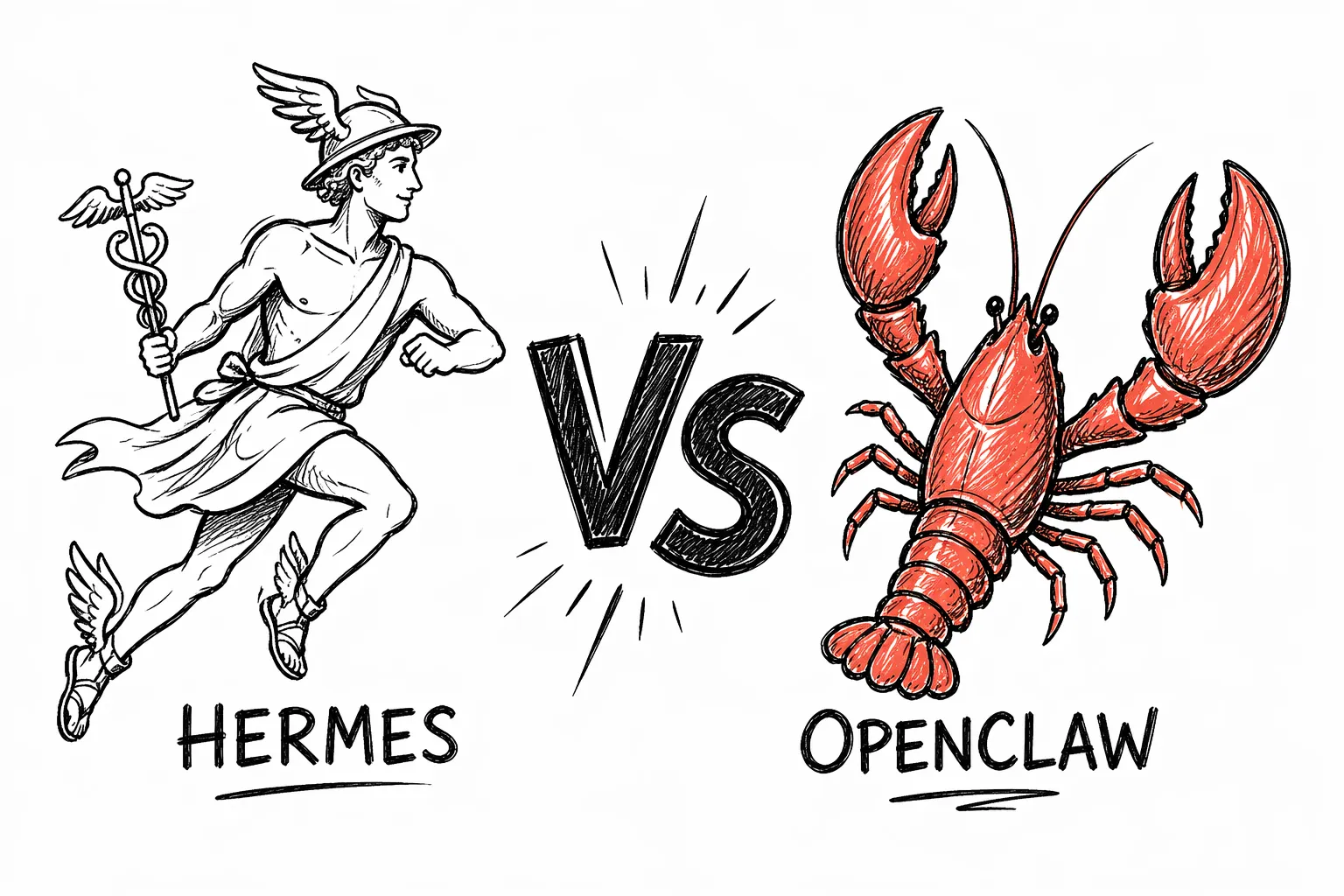
The world of artificial intelligence is undergoing its second major mutation. After the era of Chatbots like ChatGPT, we have entered the era of Agents. Two names are surfacing everywhere: Hermes and OpenClaw. While they may seem to perform similar functions, they are built on two opposing visions of digital assistance.
While OpenClaw was the first to make noise, Hermes caught the second wave of "agentic AI" hype. Although these tools are still primarily used by those comfortable with IT and software development, they are gradually evolving to allow the general public to take the reins as well.
The main strength of these two tools lies in their ability to perform all kinds of tasks on a recurring basis, whereas the average person currently uses ChatGPT or Claude simply as conversational apps.
For example, ChatGPT cannot manage your calendar or send flowers to your spouse for your wedding anniversary. This is precisely where OpenClaw and Hermes shine: they can act as executors for almost anything, all through a simple messaging app.
The Hermes Agent: The Assistant That Learns From You
The Hermes Agent (no relation to the French luxury brand) is what is known as an autonomous agent. Its uniqueness lies not just in its ability to answer questions, but in its capacity to improve over time.
Why it was created: The goal is to create a companion that doesn't start from scratch in every conversation. Hermes is designed with "long-term memory" and a reasoning capacity that allows it to adjust its behavior based on your past preferences.
Who is it for? Those seeking autonomy. You give it a vague goal (e.g., "Organize my daily tech news monitoring"), and it figures out the best method on its own.
Concrete example: If you ask it to write weekly reports, Hermes will eventually understand which tone you prefer and which sources you find unreliable, without you having to repeat yourself.
OpenClaw: The "Conductor" of Your Applications
On the other end of the spectrum, OpenClaw (recently highlighted for its ability to "pilot" a computer) isn't there to learn your personality, but to be a perfect executor.
Why it was created: To bridge the gap between AI and your daily tools (WhatsApp, Excel, Gmail). OpenClaw acts as a "Gateway." It doesn't just think; it physically interacts with web interfaces and software.
Who is it for? Those who need control and structure. It is the ideal tool for automating business processes where every step must be verifiable and precise.
Concrete example: A client contacts you on WhatsApp to place an order. OpenClaw can read the message, extract the information, log it into a management spreadsheet, and prepare an invoice—all while following a strict protocol.
The Duel: Autonomy vs. Control
The fundamental difference lies in the working method:
Hermes is the creative "brain": It is capable of taking initiative. We trust it to learn the right things through repetition.
OpenClaw is the operational "arm": It manages data flows between different platforms. It is used for its reliability and its ability to connect tools that normally do not talk to each other.
Conclusion: Which One to Choose?
As experts highlight in their demonstrations, the choice depends on your tolerance for control. If you want an agent that refines itself and becomes a digital double capable of making decisions, Hermes is the way to go. If you want a robust system that automates your digital chores without ever deviating from the script, OpenClaw is your best ally.
One thing is certain: AI is no longer just talking; it is finally starting to work.