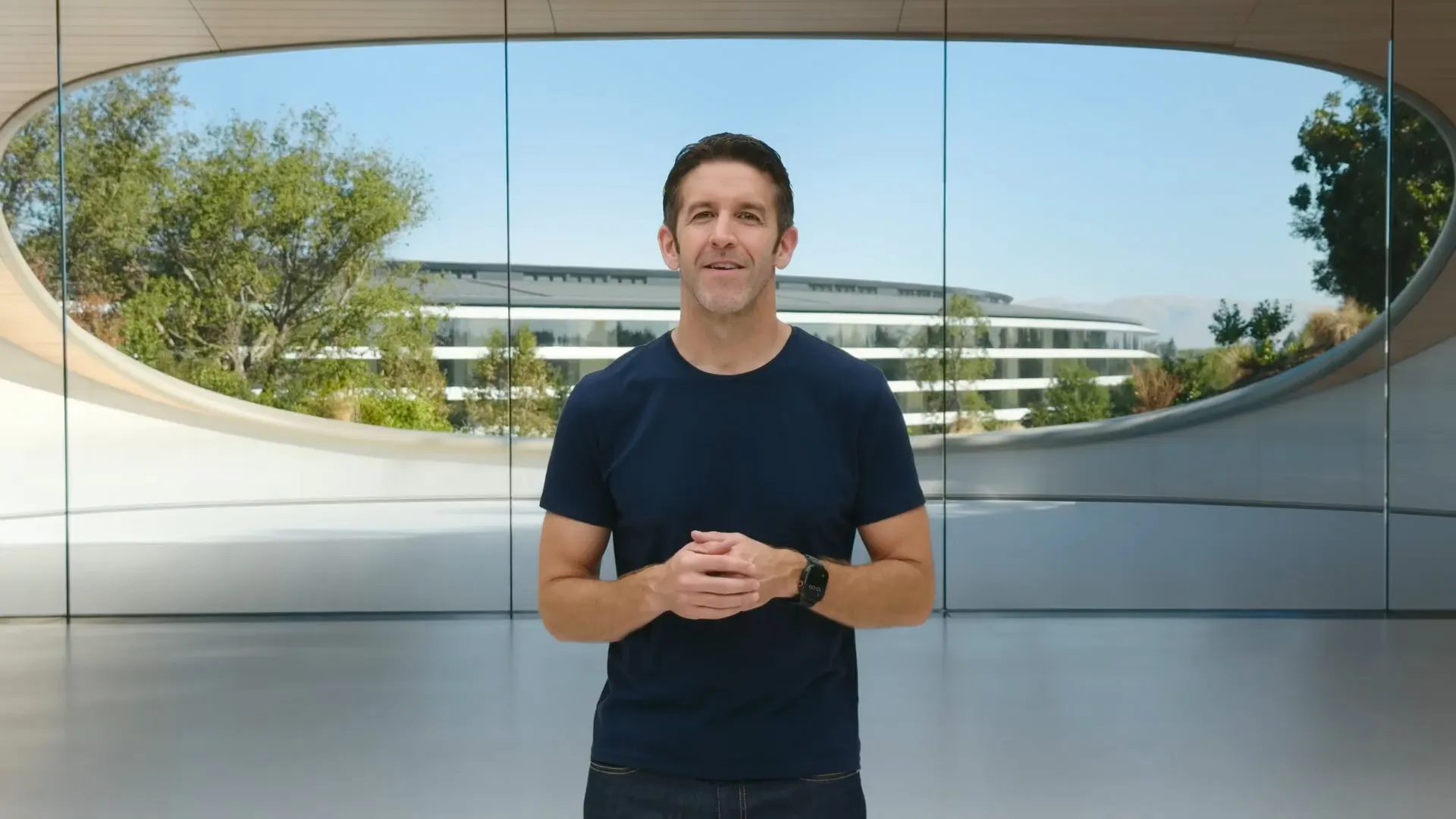
The announcement marked a strategic turning point: Apple has chosen John Ternus to succeed Tim Cook as CEO starting September 1, 2026. Behind this leadership change lies a much deeper transformation: that of a hardware giant forced to reinvent itself in the age of artificial intelligence.
John Ternus, a pure Apple insider
An engineer by training, John Ternus embodies Apple’s historical DNA. He holds a degree in mechanical engineering from the University of Pennsylvania and joined the company in 2001, steadily rising through the ranks until becoming Senior Vice President of Hardware Engineering in 2021.
Over the years, he has played a key role in the development of major products such as Macs, iPads, and AirPods. He also contributed to the strategic transition to Apple Silicon chips, which allowed the company to regain control over its hardware performance.
His profile is telling: Ternus is above all a product-focused leader, a respected engineer internally, known for his calm and consensus-driven management style, similar to Tim Cook’s.
Why is he replacing Tim Cook?
Tim Cook’s departure is anything but sudden. After 15 years as Apple’s CEO and at the age of 65, he had been preparing his succession for several years.
He is not leaving the stage entirely: Cook will become executive chairman of the board, a strategic role focused on institutional relations and overall oversight.
Ternus’s appointment follows Apple’s tradition of controlled, internal succession without abrupt disruption. Back in 2011, Cook himself succeeded Steve Jobs after a long transition period.
But this choice is not only conservative — it reflects a key belief: Apple needs a leader capable of bridging hardware and software, at a time when this integration is becoming critical with AI.
The real challenge: catching up in artificial intelligence
This is where Ternus’s mission becomes significantly more complex.
Despite its strength in hardware, Apple is widely seen as lagging behind in generative AI, trailing players like OpenAI, Google, and Anthropic. Siri, once a pioneer in voice assistants, is now often considered outdated, and recent innovations have failed to impress.
The challenge is twofold: Modernize Siri and intelligent interfaces, Integrate AI across all Apple products, from iPhone to Mac, and Create differentiated use cases, not just follow competitors
Apple has already started responding, notably by partnering with Google to enhance Siri using its Gemini models. But this also highlights a weakness: Apple still depends on external players to close the gap.
A broader strategic reshuffle
Ternus’s appointment is part of a wider set of internal moves. Apple is actively reorganizing its teams around AI, including the appointment of Amar Subramanya as head of AI efforts.
At the same time, persistent rumors suggest potential acquisitions in the AI ecosystem, including: Mistral AI, a French startup specializing in large language models, and Perplexity AI, a conversational search engine
While these deals remain unconfirmed, they point to a clear trend: Apple is exploring ways to rapidly accelerate its AI capabilities, rather than building everything in-house.
Apple at a crossroads
The context is even more critical as some recent products, such as the Vision Pro headset, have received a mixed reception.
Investors are now expecting a new wave of innovation and it will necessarily be driven by artificial intelligence.
John Ternus is therefore inheriting a company that remains extremely powerful, but is facing a major transition: from a hardware leader to a credible player in consumer AI.
His strength will likely be his deep understanding of Apple’s products. His potential limitation: he is not, by background, an AI specialist.
Conclusion
John Ternus’s appointment does not signal an immediate revolution, but it sets the stage for a profound transformation. Apple remains true to its culture: continuity, discretion, control, while trying to catch up in the AI race.
One central question remains:
Can Apple close the gap without abandoning its tightly integrated ecosystem?
It is now up to Ternus to answer it.